It’s been a sad couple of weeks. It started when my mom called to inform me that a family friend had died 11 days after being diagnosed with lung cancer. Then Phil Role died after a much longer battle with cancer. And just the other day, my friend Sarah e-mailed me that her young niece had had a skiing accident and wasn’t expected to live.
Needless to say, I’ve been doing my fair share of crying.
The memorial service for Phil was particularly moving. I barely knew him but that didn’t stop me from using plenty of the tissues someone had thoughtfully left on all the chairs. I cried, not only for his family, who must now continue on with a large gap in their life, but for myself and the hole in my life left after my dad died when I was only 20. I cried all the way home from the service. Then I had to hold off calling Sarah for a day to make sure the phone call wouldn’t just be us listening to each other sob.
Aside from shedding tears, I also had an overwhelming desire to feed both the Role family and my friend. What is it about death that makes me want to cook? Why is it that food seems to be the best way for me to express how truly sorry I am and how I wish there was something in my power to make it all better?
I’m not alone in these feelings. Feeding the bereaved has been a part of many cultures and religions since funeral rites began. Each culture has a different take on what food is served when and by whom, but the reasons behind the food are similar.
The poet Jeanne Nall Adams hints at one of the reasons for having food as part of the funeral rites. “Atop the beans he piled the ham/Atop the cake, the pie./Take time to stuff, O mourner./Full stomachs cannot cry”
But it’s not just that it’s harder to cry with your mouth full. Food focuses our thoughts on the needs of the living. People have traveled for miles and are hungry. The bereaved are too disconsolate to think about eating but still need to take in nourishment. And food may help ease the stress-induced fight or flight reaction that grief causes (your brain knows it’s not in danger if it has time to stop and eat).
Food sustains life and often the foods that are served symbolically represents life such as hard boiled eggs, or are circular to represent the circle of life such as the lentils traditional served during Jewish Shiva.
Food brings a community together and gives us something to talk over as we remember the dead.
And of course, food is comforting. Most often, funeral food is synonymous with comfort food. Folks in the southern United States have the comfort thing down and their “repasts” are filled with fried chicken, mashed potatoes, and apple pie.
Knowing that bringing food to the bereaved is the right thing to do is easy; deciding what is the most appropriate is a bit harder.
If you are bringing food for the immediate family, simple easy to serve and eat food is best. Soup or sandwiches will do the trick. Casseroles are great to bring to stock their freezer for later when things calm down and they still don’t feel like cooking.
If you are bringing food to share after a funeral service or memorial, then your favorite potluck dish is fine as long as it’s not too fancy. This is not the time to try and compete for the Iron Chef title. Everyone there is going to want comfort food so bring your favorite.
The exception to this rule is if the person whose funeral you are attending was a great lover of food. In that case, it would be in their honor to make something spectacular (please note my request for Thai green curry in the accompanying recipe).
Aside from offering comfort to the family and friends of the departed, making food and producing something nourishing and good helps heal the cook. The act of creation is a soothing balm to a mind filled with loss and sadness.
It turned out that, to date, my cooking impulse served only to sooth me. I wasn’t able to take food to Phil’s memorial (not that anyone noticed, there was enough food there to feed all of Sandpoint) and Sarah left for the East Coast before I could send her a care package. Instead, I baked a batch of cookies, thought about the loved ones I have lost, then shared them with the loved ones I still have.
Thai Green Curry over Coconut Rice
Serves 4
This isn’t your typical funeral fare but I’d like to have it served at my funeral. It’s one of my favorite foods.
3 ½ c. coconut milk (divided)
1 c. jasmine rice
2 T. green curry paste
½ c. chicken broth
3 T. fish sauce
2 T. brown sugar
1 T. sliced ginger
½ medium onion, quartered and sliced
1 red bell pepper, sliced into chunks
1 can bamboo shoots
10 oz. lean beef steak, cut into thin strips
¼ c. chopped fresh basil
¼ c. chopped fresh cilantro
Juice of one lime
In a medium saucepan, bring 2 cups of coconut milk to a boil. Stir in the rice. Lower the heat to a simmer and cover. Cook until the milk is completely absorbed and the rice is done.
Meanwhile, in a large wok, combine the remaining coconut milk, curry paste, chicken broth, fish sauce, brown sugar and ginger. Bring the mixture to a boil then reduce the heat and simmer for 10 minutes. Add the onions, red pepper, and bamboo shoots. Simmer until the vegetables are almost tender. Add the beef and continue simmering until the beef is cook through, about 5 minutes depending on how thick the slices are. Stir in the chopped herbs and remove from heat. Serve curry over the coconut rice.
This is coconut overload and can be enjoyed with plain jasmine rice when not served at my funeral.
Monday, June 21, 2010
Monday, June 7, 2010
Salt: The Only Rock We Eat
Four years ago, my mom took me to Italy for my 40th birthday present. It was an incredible trip. We saw famous art up close and personal and ate pasta and pizza like I’d never experienced. We had gelato everyday (and sometimes twice a day when it was hot). The tour took us to Rome, Florence and Venice; each of which I’d gladly go back to and spend a month exploring. We also spent a day in Siena.
 The Campo
 The Stairwell
 The View
The men behind the counter were friendly and flirtatious. They listed off all the different kinds of cured meats and cheeses they had to offer. I was overwhelmed and just asked that they make me a sandwich with whatever they liked best.
Oh my god! It was the best sandwich I have ever eaten. I have no idea what was in it or what made it so amazing. To the naked eye, it looked like a salami and cheese sandwich on good crusty bread. In my mouth, it turned into a magnificent combination of flavors and textures that I’m afraid will never be repeated.
Since then, I’ve tried and failed to find cured meat of the caliber I had in Italy. I haven’t found cheese with the same intense flavor, and I haven’t found bread with the same crusty bite. But recently I realized there is one common ingredient in all of those sandwich components, which was probably in perfect proportion in each of them, to make the whole thing come together for that consummate experience. That ingredient is salt.
Yes, lowly salt.
We take salt for granted. Sure, you know it enhances the flavor of foods, but when was the last time you thought about the fact that without salt we would all die. Salt (sodium chloride) is essential to the human body. Without it, our muscles wouldn’t work and our cells would cease to get nutrients. Of course, in our culture of highly processed foods, which are loaded with salt to make them taste slightly better than cardboard, we’re not in much danger of dying from salt deprivation.
Because our bodies need salt, we’ve developed quite a taste for it. Salt is the only one of our five tastes that only comes from one source, so we tend to add it to most of our food to round out and intensify the flavor.
But salt does more than just make food taste better. In the case of my perfect sandwich, each ingredient wouldn’t exist without it.
Bread without salt isn’t really worth eating. Besides being flavorless (with the possible exception, ironically enough, of some traditional breads from Tuscany), bread without salt lacks strength. Salt tightens up the gluten or protein matrix that is the backbone of bread. Without it, bread does not hold its shape as well or rise as high.
And that Sienese sandwich bread was stout and flavorful.
Cheese needs salt for similar reasons. It’s a flavor enhancer and it firms up the protein structure. It also helps draw whey out of the curd and regulate the ripening process. Most importantly, it destroys or inhibits the growth of bacteria and other microbes that might spoil the cheese.
I can assure you the cheese on my sandwich was perfectly ripe and flavorful without a hint of spoilage.
When it comes to cured meats, like salami, most wouldn’t exist without salt. Salt regulates the fluid exchange in cells. A concentration of salt outside the cell wall draws water out of the cell and draws salt, and any flavors added to the salt, in. It dehydrates cells and flavors them at the same time.
Salt also changes the structure of the protein molecules, unbunching them and making them firm but tender. While it’s working on the muscle cells of the meat, it’s also dehydrating and disabling any spoilage microbes, thereby preserving the meat.
And dry-cured aged meat like my salami undergoes more changes as it ages. Because the salt preserves it for months, the protein in the meat has a chance to break down into flavor molecules and the fat cells get to break apart into volatile compounds, both of which greatly enhance the flavor.
And, boy, was my sandwich meat flavorful, tender, and well preserved.
Salt has made our civilization what it is. It allowed us to explore far-off places because we could keep food fresh longer. It has been used as currency (the word salary derives from the word salt) and caused revolutions. And it made my perfect sandwich possible. I just wish there was a way to use in to get back to Siena for another one.
Gravlax (Salt and Sugar Cured Salmon)
serves 10-12
2-3 lbs center-cut fresh wild salmon fillet of fairly uniform thickness, with skin on (preferably from our local Alaska fisherman, Chris White)
4 oz. sugar
6 oz. kosher salt
2 tbs. crushed black pepper
3 tbs. Aquavit
4 oz. fresh dill sprigs
Mix the sugar, salt and crushed pepper together. Sprinkle half of it onto the bottom of a non-reactive baking dish that’s just slightly larger than the filet. Place the salmon skin-side down on the salt-sugar mixture. Pour the Aquavit over the fish. Cover the fish with the remaining salt-sugar mixture. Cover all of it with sprigs of dill. Cover with plastic wrap.
Place a flat plate or pan on top of the fish and weight it down evenly with cans or a brick (about 4-8 lbs) to compress the salmon. Refrigerate for 1-3 days, until the thickest part of the fish is firm to the touch. If it feels raw and swishy, let it cure for another day. Redistribute the cure ingredients as needed halfway through the cure.
When the salmon is firm, remove it from the cure and wash it off well. Slice it paper thin and serve on salad, bagels, or toast points with crème fraiche.
The gravlox will keep for 3 weeks in the refrigerator, wrapped in parchment paper. Change the paper if it becomes wet.
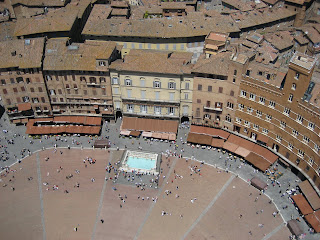
Siena is a city frozen in the Middle Ages. The center of the city, the Piazza del Campo, still hosts a horse race that has been run since medieval times.
 The Campo
The Palazzo Pubblico, at the base of the shell-shaped plaza, has a tower that beckons tourists to climb it. Well, it beckoned this tourist. Mom and the rest of our tour group stayed below and had lunch while I climbed over 500 stairs to be rewarded with a heart-stopping view.
 The Stairwell
 The View
All of Tuscany was laid out before me. I wanted to stay for hours, but the climb up had made me hungry, and being on a tour meant I had to be back to the bus on time.
When I finally got down, there wasn’t much time to eat. We slipped into what I would call a deli but what the Italians probably call by a much sexier name. I’d noticed it on our way to the Campo because of the colorful cords hanging in the doorway. It was a very simple shop with a giant display case across the back wall. Two men stood behind the case; one fat, one tall and skinny, while an older man stood in the corner washing greens.
When I finally got down, there wasn’t much time to eat. We slipped into what I would call a deli but what the Italians probably call by a much sexier name. I’d noticed it on our way to the Campo because of the colorful cords hanging in the doorway. It was a very simple shop with a giant display case across the back wall. Two men stood behind the case; one fat, one tall and skinny, while an older man stood in the corner washing greens.
Oh my god! It was the best sandwich I have ever eaten. I have no idea what was in it or what made it so amazing. To the naked eye, it looked like a salami and cheese sandwich on good crusty bread. In my mouth, it turned into a magnificent combination of flavors and textures that I’m afraid will never be repeated.
Since then, I’ve tried and failed to find cured meat of the caliber I had in Italy. I haven’t found cheese with the same intense flavor, and I haven’t found bread with the same crusty bite. But recently I realized there is one common ingredient in all of those sandwich components, which was probably in perfect proportion in each of them, to make the whole thing come together for that consummate experience. That ingredient is salt.
Yes, lowly salt.
We take salt for granted. Sure, you know it enhances the flavor of foods, but when was the last time you thought about the fact that without salt we would all die. Salt (sodium chloride) is essential to the human body. Without it, our muscles wouldn’t work and our cells would cease to get nutrients. Of course, in our culture of highly processed foods, which are loaded with salt to make them taste slightly better than cardboard, we’re not in much danger of dying from salt deprivation.
Because our bodies need salt, we’ve developed quite a taste for it. Salt is the only one of our five tastes that only comes from one source, so we tend to add it to most of our food to round out and intensify the flavor.
But salt does more than just make food taste better. In the case of my perfect sandwich, each ingredient wouldn’t exist without it.
Bread without salt isn’t really worth eating. Besides being flavorless (with the possible exception, ironically enough, of some traditional breads from Tuscany), bread without salt lacks strength. Salt tightens up the gluten or protein matrix that is the backbone of bread. Without it, bread does not hold its shape as well or rise as high.
And that Sienese sandwich bread was stout and flavorful.
Cheese needs salt for similar reasons. It’s a flavor enhancer and it firms up the protein structure. It also helps draw whey out of the curd and regulate the ripening process. Most importantly, it destroys or inhibits the growth of bacteria and other microbes that might spoil the cheese.
I can assure you the cheese on my sandwich was perfectly ripe and flavorful without a hint of spoilage.
When it comes to cured meats, like salami, most wouldn’t exist without salt. Salt regulates the fluid exchange in cells. A concentration of salt outside the cell wall draws water out of the cell and draws salt, and any flavors added to the salt, in. It dehydrates cells and flavors them at the same time.
Salt also changes the structure of the protein molecules, unbunching them and making them firm but tender. While it’s working on the muscle cells of the meat, it’s also dehydrating and disabling any spoilage microbes, thereby preserving the meat.
And dry-cured aged meat like my salami undergoes more changes as it ages. Because the salt preserves it for months, the protein in the meat has a chance to break down into flavor molecules and the fat cells get to break apart into volatile compounds, both of which greatly enhance the flavor.
And, boy, was my sandwich meat flavorful, tender, and well preserved.
Salt has made our civilization what it is. It allowed us to explore far-off places because we could keep food fresh longer. It has been used as currency (the word salary derives from the word salt) and caused revolutions. And it made my perfect sandwich possible. I just wish there was a way to use in to get back to Siena for another one.
Gravlax (Salt and Sugar Cured Salmon)
serves 10-12
2-3 lbs center-cut fresh wild salmon fillet of fairly uniform thickness, with skin on (preferably from our local Alaska fisherman, Chris White)
4 oz. sugar
6 oz. kosher salt
2 tbs. crushed black pepper
3 tbs. Aquavit
4 oz. fresh dill sprigs
Mix the sugar, salt and crushed pepper together. Sprinkle half of it onto the bottom of a non-reactive baking dish that’s just slightly larger than the filet. Place the salmon skin-side down on the salt-sugar mixture. Pour the Aquavit over the fish. Cover the fish with the remaining salt-sugar mixture. Cover all of it with sprigs of dill. Cover with plastic wrap.
Place a flat plate or pan on top of the fish and weight it down evenly with cans or a brick (about 4-8 lbs) to compress the salmon. Refrigerate for 1-3 days, until the thickest part of the fish is firm to the touch. If it feels raw and swishy, let it cure for another day. Redistribute the cure ingredients as needed halfway through the cure.
When the salmon is firm, remove it from the cure and wash it off well. Slice it paper thin and serve on salad, bagels, or toast points with crème fraiche.
The gravlox will keep for 3 weeks in the refrigerator, wrapped in parchment paper. Change the paper if it becomes wet.

Monday, May 24, 2010
Give Me Sorrel or Give Me Death
Fresh local greens are back. Finally. It was a long, potato and onion-filled winter, but now I’m gorging on fresh locally grown spring salad mix, spinach, and baby bok choy. Sure, I’ve had some store bought salad mix since that hard frost back in October, but it’s not the same (you’re lucky if lasts two days after you buy it and it’s kind of flaccid even when it’s fresh).
However, there is one green that I love for which I must wait patiently until spring. Because it starts to deteriorate so quickly after harvest, most supermarkets don’t bother carrying it. I can only find it at farmer’s markets or in my own garden. And there really is nothing else out there that compares with its lemony, acidic bite. Sorrel is my pay off for surviving the winter on root crops.
My mom was the one who introduced sorrel (Rumex acetosa) into my life. We always had a huge patch of it in the garden and she would make pots and pots of sorrel soup every spring. It was one of her favorites and she passed on her love of it to me.
I figured I would write this whole article about the wonders of this fine plant, where it originated from, and what chemical composition created its unique lemony flavor, thereby passing on my passion for sorrel to the Sandpoint community.
I did a bit of research and found that sorrel has been cultivated since the 16th century and is great in soups and as a sauce for fish. I learned that it is related to rhubarb and buckwheat. I found out that the sour bite I love so much is due to sorrel’s high oxalic acid content.
And then I learned that oxalic acid is poisonous. My mom wasn’t trying to pass on her love, she was trying to kill me, and while I’m the first to admit I was kind of a trying child, especially during my teenage years, I couldn’t believe she’d try to off me with sorrel.
Were there other foods she was trying to sneak into my diet to aid in my slow poisoning?
We’d have rhubarb pie every spring and rhubarb is also high in oxalic acid. It’s most concentrated in the leaves of the plant, not the stalk, and as far as I could tell she never slipped any leaves into my piece of pie.
Did she really not like lima beans or did she always give me her serving for nefarious reasons? Lima beans and other beans contain protease inhibitors and lectins that can interfere with proper absorption of nutrients in the digestive track and bring on symptoms of food poisoning. These toxins are inactivated by thorough cooking, but weren’t those lima beans always a bit on the crunchy side?
Was she feeding me too many alkaloids? Alkaloids are bitter tasting and toxic. Caffeine, nicotine, and quinine are a few common alkaloids. Green potatoes and potato sprouts are especially high in poisonous alkaloids, but Mom never served sprouting potatoes. She has always been a big fan of coffee and vodka tonics (tonic water gets its bitter flavor from quinine) but never pushed these on me as a kid. She did try to get me addicted to coffee soda for a while, but she was drinking more of it than me. Maybe she was using some other food to do me in.
Maybe it was the bamboo shoots? She would always add them to her delicious stir-fries. Bamboo shoots, if not properly prepared, contain high levels of cyanogens. Cyanogens break down in the body into hydrogen cyanide and can cause cyanide poisoning. I’m sure I saw her take them out of a can and I would guess the manufacturer made sure they were cyanide-free, but I can’t be sure.
She always encouraged me to eat lots of citrus, stone, and pome fruits, the seeds of which are high in cyanide generating chemicals, but at the same time she did advise me not to eat the seeds. Was Mom using some kind of reverse psychology on me? Did she secretly want me to chew my apple seeds?
All those interesting and not necessarily kid-friendly flavors that Mom had me try might have been another way for her to introduce toxins into my diet. Glycyrrhizin, the sweet flavor in licorice root, could have raised my blood pressure to dangerous levels. Coumarin in lavender could have interfered with blood clotting. And myristicin in nutmeg could have made me hallucinate so I wouldn’t notice any of it.
She may even have gotten my dad involved. Dad was the grill master in the family. Was he introducing too many PAHs (polycyclic aromatic hydrocarbons) into my meat when he was barbecuing? PAHs are carcinogens that are formed when wood burns and are carried into the meat if it is cooked over high heat in an enclosed environment. But wouldn’t everyone’s meat be tainted, not just mine? And didn’t we have a gas grill with no wood to form PAHs?
Maybe I’m just being paranoid. Maybe my parents were trying to expose me to a wide range of foods and flavors to expand my palette, not poison me. Maybe my parents wanted to pass on their love of good food as a way to show their love for me, despite what a royal pain in the butt I was. And if that’s the case, I’m off to make a big pot of sorrel soup.
Vicki Reich lives in Sagle and loves her mom. She doesn’t believe for a second her mom ever actually tried to poison her (although she definitely had just cause) and only used the idea for entertainment purposes.
Sorrel Soup
Serves 4
1 tbls. Butter
1 large onion, chopped
4 c. chicken broth
1-2 large potatoes, peeled and diced (more potatoes makes a creamier soup)
3 c. chopped sorrel
Salt and pepper to taste
Plain yogurt or sour cream for garnish
Heat butter in a stock pot over medium high heat until melted. Add onion and sauté for five minutes or until the onion softens. Add the broth and potato. Bring to a boil then lower heat to a simmer. Simmer until potato is soft, 20-30 minutes. Add sorrel and simmer for 10 minutes. Add salt and pepper to taste. Puree in batches in a blender or in the pot with an immersion blender. Serve hot or cold with a dollop of yogurt or sour cream.
However, there is one green that I love for which I must wait patiently until spring. Because it starts to deteriorate so quickly after harvest, most supermarkets don’t bother carrying it. I can only find it at farmer’s markets or in my own garden. And there really is nothing else out there that compares with its lemony, acidic bite. Sorrel is my pay off for surviving the winter on root crops.
My mom was the one who introduced sorrel (Rumex acetosa) into my life. We always had a huge patch of it in the garden and she would make pots and pots of sorrel soup every spring. It was one of her favorites and she passed on her love of it to me.
I figured I would write this whole article about the wonders of this fine plant, where it originated from, and what chemical composition created its unique lemony flavor, thereby passing on my passion for sorrel to the Sandpoint community.
I did a bit of research and found that sorrel has been cultivated since the 16th century and is great in soups and as a sauce for fish. I learned that it is related to rhubarb and buckwheat. I found out that the sour bite I love so much is due to sorrel’s high oxalic acid content.
And then I learned that oxalic acid is poisonous. My mom wasn’t trying to pass on her love, she was trying to kill me, and while I’m the first to admit I was kind of a trying child, especially during my teenage years, I couldn’t believe she’d try to off me with sorrel.
Were there other foods she was trying to sneak into my diet to aid in my slow poisoning?
We’d have rhubarb pie every spring and rhubarb is also high in oxalic acid. It’s most concentrated in the leaves of the plant, not the stalk, and as far as I could tell she never slipped any leaves into my piece of pie.
Did she really not like lima beans or did she always give me her serving for nefarious reasons? Lima beans and other beans contain protease inhibitors and lectins that can interfere with proper absorption of nutrients in the digestive track and bring on symptoms of food poisoning. These toxins are inactivated by thorough cooking, but weren’t those lima beans always a bit on the crunchy side?
Was she feeding me too many alkaloids? Alkaloids are bitter tasting and toxic. Caffeine, nicotine, and quinine are a few common alkaloids. Green potatoes and potato sprouts are especially high in poisonous alkaloids, but Mom never served sprouting potatoes. She has always been a big fan of coffee and vodka tonics (tonic water gets its bitter flavor from quinine) but never pushed these on me as a kid. She did try to get me addicted to coffee soda for a while, but she was drinking more of it than me. Maybe she was using some other food to do me in.
Maybe it was the bamboo shoots? She would always add them to her delicious stir-fries. Bamboo shoots, if not properly prepared, contain high levels of cyanogens. Cyanogens break down in the body into hydrogen cyanide and can cause cyanide poisoning. I’m sure I saw her take them out of a can and I would guess the manufacturer made sure they were cyanide-free, but I can’t be sure.
She always encouraged me to eat lots of citrus, stone, and pome fruits, the seeds of which are high in cyanide generating chemicals, but at the same time she did advise me not to eat the seeds. Was Mom using some kind of reverse psychology on me? Did she secretly want me to chew my apple seeds?
All those interesting and not necessarily kid-friendly flavors that Mom had me try might have been another way for her to introduce toxins into my diet. Glycyrrhizin, the sweet flavor in licorice root, could have raised my blood pressure to dangerous levels. Coumarin in lavender could have interfered with blood clotting. And myristicin in nutmeg could have made me hallucinate so I wouldn’t notice any of it.
She may even have gotten my dad involved. Dad was the grill master in the family. Was he introducing too many PAHs (polycyclic aromatic hydrocarbons) into my meat when he was barbecuing? PAHs are carcinogens that are formed when wood burns and are carried into the meat if it is cooked over high heat in an enclosed environment. But wouldn’t everyone’s meat be tainted, not just mine? And didn’t we have a gas grill with no wood to form PAHs?
Maybe I’m just being paranoid. Maybe my parents were trying to expose me to a wide range of foods and flavors to expand my palette, not poison me. Maybe my parents wanted to pass on their love of good food as a way to show their love for me, despite what a royal pain in the butt I was. And if that’s the case, I’m off to make a big pot of sorrel soup.
Vicki Reich lives in Sagle and loves her mom. She doesn’t believe for a second her mom ever actually tried to poison her (although she definitely had just cause) and only used the idea for entertainment purposes.
Sorrel Soup
Serves 4
1 tbls. Butter
1 large onion, chopped
4 c. chicken broth
1-2 large potatoes, peeled and diced (more potatoes makes a creamier soup)
3 c. chopped sorrel
Salt and pepper to taste
Plain yogurt or sour cream for garnish
Heat butter in a stock pot over medium high heat until melted. Add onion and sauté for five minutes or until the onion softens. Add the broth and potato. Bring to a boil then lower heat to a simmer. Simmer until potato is soft, 20-30 minutes. Add sorrel and simmer for 10 minutes. Add salt and pepper to taste. Puree in batches in a blender or in the pot with an immersion blender. Serve hot or cold with a dollop of yogurt or sour cream.
Tuesday, May 11, 2010
I Like Meat, Meat is Good
My husband is a carnivore. There is no denying it. Meals without meat are not truly meals in his mind. And you can’t really blame him. Meat is delicious and we are biologically rigged to think so. Our sense of smell and taste has evolved to let us know what foods are good sources of energy and nutrition. Our taste buds can perceive essential elements in food that keep us alive. The taste of meat tells our brains that it’s got the salts, sugars and amino acids we need to fuel our bodies. And the smell of cooking meat, well, that just makes us salivate.
Meat fueled the development of our big brains. It was the concentrated energy source we needed to withstand long migrations and cold climates. Meat has made us who we are today and how can you blame Jon if it’s hard for him to overcome 100,000 years of evolution.
But meat today isn’t the same as what our ancestors were eating. The age and fat content of meat has changed quite a bit in the last hundred or so years. Meat animals used to be slaughtered at much older ages. Most animals had some primary purpose like providing labor, milk, eggs or wool and were only slaughtered after they were no longer useful for those tasks. The meat from these animals was tough but had much more flavor and character. This was due to greater muscle development (which leads to toughness but also more flavor) and to greater accumulation of flavor characteristics in the fat.
As the middle class rose in affluence and the demand for more meat increased, production began to specialize in animals raised only for meat. And there was a profit to be made from raising animals as quickly as possible and slaughtering them at a young age. This lead to tenderer, fattier and less flavorful cuts.
It also led to CAFOs (confined animal feeding operations) and the desire to squeeze an extra penny of profit out of each animal. Because of that, industrially produced meat is chock full of hormones and antibiotics. Animals are raised in inhumane and cramped conditions then forced to eat waste products from other animal productions, all of which breeds diseases like E.-coli, Salmonella, and mad cow disease. It’s not very appetizing no matter how good it smells on the grill.
And while my husband loves his meat, he (and I) can’t stomach all the yucky stuff that’s in industrial meat. We buy our meat from local farmers who raise their animals humanely and feed them only grass.
Grass-fed meat varies in a number of ways from what you find in the grocer store. It’s lower in fat and the fat it does have is better for you. It’s more flavorful and may take some getting used to if all you eat is bland supermarket fare. It’s also from older animals (if you pump an animal full of growth hormones and feed it on grain, it reaches market weight a lot sooner than if you just let it graze on pasture).
These distinctions mean you have to cook grass fed meat differently. It only took one experience of overcooking a steak into a tough, unappetizing disaster, before I knew it was time to learn more about what was happening when meat cooked. After all, when you pay a premium for good, clean meat, you want to make sure you cook it right every time.
I turned to the bible of cooking information, “On Food and Cooking” by Harold McGee, opened to the chapter on meat, and read all 50 pages like it was a spy novel (it really is that fascinating). I learned that the muscle of different animals tastes pretty much the same and it’s the fat that gives each animal it’s characteristic taste and smell (and that there is a molecule in pork that also gives coconut it’s characteristic taste, no wonder I find bacon irresistible).
I learned that the amount of use and the type of use each muscle (and therefore each cut of meat) withstood over an animal’s lifetime determined its tenderness or toughness.
And I learned that juiciness in meat occurs for two different reasons. The first is when tender meat is cooked to the perfect temperature where it just starts to release the water stored between its muscle fibers, as in a steak cooked rare. The second is when meat is slowly raised in temperature past the point when the collagen between the bundles of muscle fibers breaks down into gelatin creating a soft, chewable, and succulent structure, as in falling-off-the-bone lamb shanks.
But most importantly, I learned how to use my newfound knowledge to perfectly cook grass-fed meat.
I was most interested in perfecting the cooking of tender cuts of meat on the grill. These are Jon’s favorites and include chops, breasts, sirloin, t-bone and tenderloin. According to McGee, the key is to aim for an internal temperature of no more than 140F when the meat is served, without completely overcooking the outside (140F is the temperature where the muscle fibers give up all their moisture, resulting in that dreaded dried out $20 steak).
This is easier said than done. You want to brown the meat with high heat to produce a plethora of aromatic compounds that only happen when the meat is browned, but you don’t want to heat it so much that the internal temperature gets too high and squeezes out all the moisture. You also need to remember that meat will continue to cook after it’s removed from the heat. How much it continues to cook depends on the thickness, the fat content, the starting temperature and the surface treatment.
There are several ways to wrangle all of these variables into the perfectly cooked steak. Starting with a piece of meat that is at least at room temperature minimizes the length of time it takes the interior to reach 140F and minimized the chance of overcooking the outside.
Another trick is to cook the meat at two different temperatures. Place the meat on hot coals to start but make sure there is a section of your grill that is cooler. Flip the meat after a minute or so, just to brown it well on both sides, then move it to the cooler location. Continue to flip it regularly and check for doneness by touch. Brushing the meat with a water based marinade can also help keep the outside cool through evaporation.
A rare piece of meat, when poked with your finger, feels like the muscle between your thumb and forefinger when your fingers are slightly stretched apart (now you know if you are ever at our house and Jon directs me to go poke the meat it’s not some sexually deviant behavior). To me, this is meat at its most perfect, but if you like your meat medium rare, your poke should feel like that thumb muscle when your thumb and finger are squeezed together. When your poke feels right, by all means, take it off the grill immediately. Meat can go from perfect to well-done in a blink of an eye. And if you are in doubt, it will not ruin the meat to cut in and take a look inside.
Dealing with tougher cuts of meat requires a whole different approach. To create moist, tender meat from the cuts that saw the most exercise in their animal form requires slow cooking past 160F. This is the temperature when the collagen begins to convert to gelatin and the muscle fibers begin to separate. It’s also past the point where the muscles give up their moisture making it much more likely that it will be dry if not cooked right.
The slower the meat is brought up to temperature the more tender it will be. Adding moisture to replace the moisture lost from the muscle itself keeps the meat juicy. Several cooking methods help to achieve these two goals. Traditional barbeque, where the meat is cooked all day with indirect heat that never gets above 250F and is slathered in sauce the whole time is a perfect example. Roasts that are cooked in a 250F or lower oven for hours come out quite tasty especially if they are basted occasionally. Cooking the meat slowly in some type of liquid by such methods as braising, poaching or stewing infused the meat not only with moisture but with the flavor of the cooking liquid. All of these slow cooking methods benefit from a quick browning before they start their slow journey to tenderness, not because it seals in the juices as we’ve all been led to believe at one time or another, but to bring out those browning aromas that only occur at high temperatures. Letting the meat “rest” and come down to 120F will actually increase the moistness of the meat and improve the texture. This can take up to an hour and is not optional if you want to serve up perfection.
We’ve been applying all this new knowledge to grilling but haven’t yet tried it out with slow cooking. I’ve got a brisket thawing for this weekend to see if I can make my mom’s brisket recipe as good as she does. I’ll keep you posted.
Mom’s Brisket
serves 4 with lots of leftovers
2 tbls oil
1 brisket (4-5lb)
1 onion, sliced
3 carrots, cut into 1 inch pieces
1+ cup Ketchup (I like to use enough to cover the meat)
1 cup Red Wine (or more if needed)
Salt and Pepper to taste
Rinse off the brisket and pat dry. In a large pot with a lid, heat the oil over high heat. Quickly brown the meat on all sides. Remove the pot from the heat and add the remaining ingredients. Place the pot over very low heat and cover. Cook for at least two hours or until the internal temperature reaches 120F, turning occasionally. Raise the temperature to medium low, so that the liquids are barely simmering and continue cooking and turning for another hour. If the moisture evaporates, add more wine or water. After the additional hour, start checking for doneness every half hour. The meat is done when a fork pierces it easily. Remove from heat and allow it to cool to 120F. Remove the meat, slice it across the grain, and return it to the pot. Serve immediately.
Meat fueled the development of our big brains. It was the concentrated energy source we needed to withstand long migrations and cold climates. Meat has made us who we are today and how can you blame Jon if it’s hard for him to overcome 100,000 years of evolution.
But meat today isn’t the same as what our ancestors were eating. The age and fat content of meat has changed quite a bit in the last hundred or so years. Meat animals used to be slaughtered at much older ages. Most animals had some primary purpose like providing labor, milk, eggs or wool and were only slaughtered after they were no longer useful for those tasks. The meat from these animals was tough but had much more flavor and character. This was due to greater muscle development (which leads to toughness but also more flavor) and to greater accumulation of flavor characteristics in the fat.
As the middle class rose in affluence and the demand for more meat increased, production began to specialize in animals raised only for meat. And there was a profit to be made from raising animals as quickly as possible and slaughtering them at a young age. This lead to tenderer, fattier and less flavorful cuts.
It also led to CAFOs (confined animal feeding operations) and the desire to squeeze an extra penny of profit out of each animal. Because of that, industrially produced meat is chock full of hormones and antibiotics. Animals are raised in inhumane and cramped conditions then forced to eat waste products from other animal productions, all of which breeds diseases like E.-coli, Salmonella, and mad cow disease. It’s not very appetizing no matter how good it smells on the grill.
And while my husband loves his meat, he (and I) can’t stomach all the yucky stuff that’s in industrial meat. We buy our meat from local farmers who raise their animals humanely and feed them only grass.
Grass-fed meat varies in a number of ways from what you find in the grocer store. It’s lower in fat and the fat it does have is better for you. It’s more flavorful and may take some getting used to if all you eat is bland supermarket fare. It’s also from older animals (if you pump an animal full of growth hormones and feed it on grain, it reaches market weight a lot sooner than if you just let it graze on pasture).
These distinctions mean you have to cook grass fed meat differently. It only took one experience of overcooking a steak into a tough, unappetizing disaster, before I knew it was time to learn more about what was happening when meat cooked. After all, when you pay a premium for good, clean meat, you want to make sure you cook it right every time.
I turned to the bible of cooking information, “On Food and Cooking” by Harold McGee, opened to the chapter on meat, and read all 50 pages like it was a spy novel (it really is that fascinating). I learned that the muscle of different animals tastes pretty much the same and it’s the fat that gives each animal it’s characteristic taste and smell (and that there is a molecule in pork that also gives coconut it’s characteristic taste, no wonder I find bacon irresistible).
I learned that the amount of use and the type of use each muscle (and therefore each cut of meat) withstood over an animal’s lifetime determined its tenderness or toughness.
And I learned that juiciness in meat occurs for two different reasons. The first is when tender meat is cooked to the perfect temperature where it just starts to release the water stored between its muscle fibers, as in a steak cooked rare. The second is when meat is slowly raised in temperature past the point when the collagen between the bundles of muscle fibers breaks down into gelatin creating a soft, chewable, and succulent structure, as in falling-off-the-bone lamb shanks.
But most importantly, I learned how to use my newfound knowledge to perfectly cook grass-fed meat.
I was most interested in perfecting the cooking of tender cuts of meat on the grill. These are Jon’s favorites and include chops, breasts, sirloin, t-bone and tenderloin. According to McGee, the key is to aim for an internal temperature of no more than 140F when the meat is served, without completely overcooking the outside (140F is the temperature where the muscle fibers give up all their moisture, resulting in that dreaded dried out $20 steak).
This is easier said than done. You want to brown the meat with high heat to produce a plethora of aromatic compounds that only happen when the meat is browned, but you don’t want to heat it so much that the internal temperature gets too high and squeezes out all the moisture. You also need to remember that meat will continue to cook after it’s removed from the heat. How much it continues to cook depends on the thickness, the fat content, the starting temperature and the surface treatment.
There are several ways to wrangle all of these variables into the perfectly cooked steak. Starting with a piece of meat that is at least at room temperature minimizes the length of time it takes the interior to reach 140F and minimized the chance of overcooking the outside.
Another trick is to cook the meat at two different temperatures. Place the meat on hot coals to start but make sure there is a section of your grill that is cooler. Flip the meat after a minute or so, just to brown it well on both sides, then move it to the cooler location. Continue to flip it regularly and check for doneness by touch. Brushing the meat with a water based marinade can also help keep the outside cool through evaporation.
A rare piece of meat, when poked with your finger, feels like the muscle between your thumb and forefinger when your fingers are slightly stretched apart (now you know if you are ever at our house and Jon directs me to go poke the meat it’s not some sexually deviant behavior). To me, this is meat at its most perfect, but if you like your meat medium rare, your poke should feel like that thumb muscle when your thumb and finger are squeezed together. When your poke feels right, by all means, take it off the grill immediately. Meat can go from perfect to well-done in a blink of an eye. And if you are in doubt, it will not ruin the meat to cut in and take a look inside.
Dealing with tougher cuts of meat requires a whole different approach. To create moist, tender meat from the cuts that saw the most exercise in their animal form requires slow cooking past 160F. This is the temperature when the collagen begins to convert to gelatin and the muscle fibers begin to separate. It’s also past the point where the muscles give up their moisture making it much more likely that it will be dry if not cooked right.
The slower the meat is brought up to temperature the more tender it will be. Adding moisture to replace the moisture lost from the muscle itself keeps the meat juicy. Several cooking methods help to achieve these two goals. Traditional barbeque, where the meat is cooked all day with indirect heat that never gets above 250F and is slathered in sauce the whole time is a perfect example. Roasts that are cooked in a 250F or lower oven for hours come out quite tasty especially if they are basted occasionally. Cooking the meat slowly in some type of liquid by such methods as braising, poaching or stewing infused the meat not only with moisture but with the flavor of the cooking liquid. All of these slow cooking methods benefit from a quick browning before they start their slow journey to tenderness, not because it seals in the juices as we’ve all been led to believe at one time or another, but to bring out those browning aromas that only occur at high temperatures. Letting the meat “rest” and come down to 120F will actually increase the moistness of the meat and improve the texture. This can take up to an hour and is not optional if you want to serve up perfection.
We’ve been applying all this new knowledge to grilling but haven’t yet tried it out with slow cooking. I’ve got a brisket thawing for this weekend to see if I can make my mom’s brisket recipe as good as she does. I’ll keep you posted.
Mom’s Brisket
serves 4 with lots of leftovers
2 tbls oil
1 brisket (4-5lb)
1 onion, sliced
3 carrots, cut into 1 inch pieces
1+ cup Ketchup (I like to use enough to cover the meat)
1 cup Red Wine (or more if needed)
Salt and Pepper to taste
Rinse off the brisket and pat dry. In a large pot with a lid, heat the oil over high heat. Quickly brown the meat on all sides. Remove the pot from the heat and add the remaining ingredients. Place the pot over very low heat and cover. Cook for at least two hours or until the internal temperature reaches 120F, turning occasionally. Raise the temperature to medium low, so that the liquids are barely simmering and continue cooking and turning for another hour. If the moisture evaporates, add more wine or water. After the additional hour, start checking for doneness every half hour. The meat is done when a fork pierces it easily. Remove from heat and allow it to cool to 120F. Remove the meat, slice it across the grain, and return it to the pot. Serve immediately.
Monday, March 29, 2010
A Few of Our Favorite Things
For the past 5 years, my friends and I have spent the last weekend in March having a grand time at a monastery (an odd combination considering only two of my friends are practicing Catholics and more than that are staunch atheists). The Monastery of St. Gertrude’s in Cottonwood, Idaho is set on a hill overlooking the Camas Prairie and is home to about 50 Benedictine nuns. They are “committed to fostering Healing Hospitality, Grateful Simplicity and Creative Peacemaking in the world”. The nuns I have met are kind and seem genuinely happy to welcome us to their home. I’m sure in their own way they, too, are having a grand time, we’re just not having them together.
Instead, our fun happens across the street from the imposing main brick building in an old farm house that sleeps fifteen. This year there were thirteen of us. We are all handspinners and we all used to live in Moscow (two of us are no longer Moscow residents). We call ourselves The Hog Heaven Handspinners. The group that is still in Moscow meets once a week to spin, knit, chat, eat, and drink. Some iteration of the group has been doing that every week for the last twenty years.
Five years ago we decided that once a week was not quite enough time to get our fill of those activities, so once a year we head down to the monastery to spend a weekend together. We arrive with armloads of fiber, spinning wheels, snacks, booze, and knitting projects.
We each claim a spot in the big living room, with glorious views of the prairie and the mountain ranges beyond, and get down to the business of making stuff. While we create, we talk, eat, and drink. The kitchen counter is covered with tempting treats ranging from a healthy bowl of fresh fruit to a not so healthy bowl of candy. Part of the counter looks like a wine store and the refrigerator is packed with beer, cheese, veggies and other delicacies.
Time has little meaning; we graze all day and start drinking with a dash of homemade Irish Cream in our morning coffee. Some of us will join the nuns in their dining hall for a meal or two, which is always homey and satisfying (and with some of the best homemade pickles I’ve ever eaten), but most of the time we can’t be torn away from our work and our talk.
There is no topic of conversation that hasn’t been touched on at one of our retreats. But besides fiber, the one topic we can always count on discussing is food. We discuss what we’ll snack on next, how delicious everything we made is, and how we really shouldn’t be eating so much of it, but oh well, it’s only for one weekend. I counted on this topic being brought up this year because I knew I’d have to come home from the retreat and write this article. I was hoping to get some good input from my friends.
As I drove down to Cottonwood, I came up with a few questions that might spur an idea for an article. What is your definition of good food? What’s your favorite food? What’s your favorite comfort food? None of them seemed quite right so when I broke out my laptop and begged everyone to help me with my article I wasn’t really sure where I was going to lead them. I started with “What’s your favorite food?” I got a few immediate responses. Sarah S. said “toast” right away and Jane followed with “fish soup.” Everyone else just stared at their spinning wheels or knitting needles. Then Rochelle came to my rescue.
Now before I tell you what she said, I have to explain something about Rochelle. She likes to think about stuff (a lot). She looks at her choices from every angle before she makes a decision. She contemplates every possible outcome, both the possible and the seemingly impossible. She frets about things I’ve never even thought about. Oh yeah, and she reads lots of fairytales.
So it was completely in keeping with her personality when, instead of answering my question, she said she had thought deeply about what she would choose if an evil genie told her she could only taste five flavors for the rest of her life. She had narrowed it down to “avocados, bacon, blackberries, milk chocolate, and garlic.”
I tried to come up with just 5 flavors that I could live with for the rest of my life and my list consisted of cheese, bread, wine, chocolate, and huckleberries. Then I started going around the room. Sarah S. said “toast, rice, apples, cheese and lettuce.” Jane said “chocolate, coconut, mango, blue cheese, and fish soup.” I paused in my typing. How could I have forgotten coconut from my list? It’s one of my favorites. I added it. Nancie said “roasted almonds, dark chocolate, red wine, toast, and curry.” Andrea said “coffee, wine, chocolates, greens, and cheese.” Robin insisted on corn, chocolate, wine, olives, watercress. Oh corn, I thought, I love corn. I can’t live without that? It went on the list.
Nicole said “bagettes, brie, Sungold cherry tomatoes, and green beans.” Sarah W’s list was black beans, garlic, tomatoes, avocado, and corn. Ivy piped in with “arugula, peaches, bread, coffee, chocolate.” Arugula is one of my favorites; it had to be on my list, too.
Amy started off her list definitively with sourdough waffles then added cheese, oranges, crab, and Caprese salad (she said this knowing full well that Caprese salad was composed of tomatoes, fresh mozzarella and basil, but I gave it to her and admired the way she got those extra flavors into one item). Laura said she had to have salt, garlic, olives, bread, and coffee with cream and sugar (she could live without black coffee). Then finally Sandy came up with chocolate, coffee, eggs, pork, pasta. At the mention of eggs, Nancie wanted to add poached eggs to her list and then Laura started weighing whether it was bread or pasta that she wanted to keep on her list. Meanwhile I had added beer to my list which was now well over five items long.The conversation devolved into blissful descriptions of all the foods and flavors we love. Our lists got longer and we gloried in the fact that we could eat all of our favorite foods without fear and came to the moral of our story: everyone should be happy that there are no evil genies.
 Irish Cream
makes about 1 liter
I originally got this recipe from Robin (of corn, chocolate, wine, olive and watercress fame). I’ve brought it to retreat for the last two years. This year it was only thanks to Rochelle that I remembered. It’s great straight and it’s really wonderful in coffee on weekend mornings.
1 can sweetened condensed milk
1 c. Irish whiskey
2 raw eggs (I always use fresh local eggs and haven’t died from it yet)
1 c. heavy cream
2 T. chocolate syrup
2 t. coconut extract
1 t. vanilla extract
Place all ingredients in a blender. Blend until well combined. Pour into bottles and keep refrigerated. Keeps for at least a month.
Instead, our fun happens across the street from the imposing main brick building in an old farm house that sleeps fifteen. This year there were thirteen of us. We are all handspinners and we all used to live in Moscow (two of us are no longer Moscow residents). We call ourselves The Hog Heaven Handspinners. The group that is still in Moscow meets once a week to spin, knit, chat, eat, and drink. Some iteration of the group has been doing that every week for the last twenty years.
Five years ago we decided that once a week was not quite enough time to get our fill of those activities, so once a year we head down to the monastery to spend a weekend together. We arrive with armloads of fiber, spinning wheels, snacks, booze, and knitting projects.
We each claim a spot in the big living room, with glorious views of the prairie and the mountain ranges beyond, and get down to the business of making stuff. While we create, we talk, eat, and drink. The kitchen counter is covered with tempting treats ranging from a healthy bowl of fresh fruit to a not so healthy bowl of candy. Part of the counter looks like a wine store and the refrigerator is packed with beer, cheese, veggies and other delicacies.
Time has little meaning; we graze all day and start drinking with a dash of homemade Irish Cream in our morning coffee. Some of us will join the nuns in their dining hall for a meal or two, which is always homey and satisfying (and with some of the best homemade pickles I’ve ever eaten), but most of the time we can’t be torn away from our work and our talk.
There is no topic of conversation that hasn’t been touched on at one of our retreats. But besides fiber, the one topic we can always count on discussing is food. We discuss what we’ll snack on next, how delicious everything we made is, and how we really shouldn’t be eating so much of it, but oh well, it’s only for one weekend. I counted on this topic being brought up this year because I knew I’d have to come home from the retreat and write this article. I was hoping to get some good input from my friends.
As I drove down to Cottonwood, I came up with a few questions that might spur an idea for an article. What is your definition of good food? What’s your favorite food? What’s your favorite comfort food? None of them seemed quite right so when I broke out my laptop and begged everyone to help me with my article I wasn’t really sure where I was going to lead them. I started with “What’s your favorite food?” I got a few immediate responses. Sarah S. said “toast” right away and Jane followed with “fish soup.” Everyone else just stared at their spinning wheels or knitting needles. Then Rochelle came to my rescue.
Now before I tell you what she said, I have to explain something about Rochelle. She likes to think about stuff (a lot). She looks at her choices from every angle before she makes a decision. She contemplates every possible outcome, both the possible and the seemingly impossible. She frets about things I’ve never even thought about. Oh yeah, and she reads lots of fairytales.
So it was completely in keeping with her personality when, instead of answering my question, she said she had thought deeply about what she would choose if an evil genie told her she could only taste five flavors for the rest of her life. She had narrowed it down to “avocados, bacon, blackberries, milk chocolate, and garlic.”
I tried to come up with just 5 flavors that I could live with for the rest of my life and my list consisted of cheese, bread, wine, chocolate, and huckleberries. Then I started going around the room. Sarah S. said “toast, rice, apples, cheese and lettuce.” Jane said “chocolate, coconut, mango, blue cheese, and fish soup.” I paused in my typing. How could I have forgotten coconut from my list? It’s one of my favorites. I added it. Nancie said “roasted almonds, dark chocolate, red wine, toast, and curry.” Andrea said “coffee, wine, chocolates, greens, and cheese.” Robin insisted on corn, chocolate, wine, olives, watercress. Oh corn, I thought, I love corn. I can’t live without that? It went on the list.
Nicole said “bagettes, brie, Sungold cherry tomatoes, and green beans.” Sarah W’s list was black beans, garlic, tomatoes, avocado, and corn. Ivy piped in with “arugula, peaches, bread, coffee, chocolate.” Arugula is one of my favorites; it had to be on my list, too.
Amy started off her list definitively with sourdough waffles then added cheese, oranges, crab, and Caprese salad (she said this knowing full well that Caprese salad was composed of tomatoes, fresh mozzarella and basil, but I gave it to her and admired the way she got those extra flavors into one item). Laura said she had to have salt, garlic, olives, bread, and coffee with cream and sugar (she could live without black coffee). Then finally Sandy came up with chocolate, coffee, eggs, pork, pasta. At the mention of eggs, Nancie wanted to add poached eggs to her list and then Laura started weighing whether it was bread or pasta that she wanted to keep on her list. Meanwhile I had added beer to my list which was now well over five items long.The conversation devolved into blissful descriptions of all the foods and flavors we love. Our lists got longer and we gloried in the fact that we could eat all of our favorite foods without fear and came to the moral of our story: everyone should be happy that there are no evil genies.
 Irish Cream
makes about 1 liter
I originally got this recipe from Robin (of corn, chocolate, wine, olive and watercress fame). I’ve brought it to retreat for the last two years. This year it was only thanks to Rochelle that I remembered. It’s great straight and it’s really wonderful in coffee on weekend mornings.
1 can sweetened condensed milk
1 c. Irish whiskey
2 raw eggs (I always use fresh local eggs and haven’t died from it yet)
1 c. heavy cream
2 T. chocolate syrup
2 t. coconut extract
1 t. vanilla extract
Place all ingredients in a blender. Blend until well combined. Pour into bottles and keep refrigerated. Keeps for at least a month.
Wednesday, March 17, 2010
Industrial Food is Not My Friend
I’m on the board of directors of an organization called Provender Alliance. The purpose of the organization is to educate and inspire our members about healthy food and products. We serve all aspects of the Natural Food Industry: retailers, manufacturers, distributors, and to some extent farmers and consumers. We put on a yearly conference of workshops and speakers.
This year our keynote speaker is Raj Patel. His name sounded familiar when it first came up as a possibility. A quick internet check revealed that he was quite good looking and had a lovely English accent (check out his website and you'll see what I mean). Aside from those two very important facts, I learned he had recently written two books: Stuffed and Starved; The Hidden Battle for the World Food System and The Value of Nothing; How to Reshape Market Society and Redefine Democracy.
When we got word that he was going to be our keynote speaker, I immediately got on the Sandpoint Library website to see if his books were available. I put a hold on both of them and, of course, they both came in at the same time and I had only two weeks to read them. I’ve been trying to read both of them simultaneously, which, it turns out, isn’t too hard. The concepts in both books overlap nicely and they both deal with a subject that is near and dear to my heart: the myth of cheap food, why it exists, the harm it does, and what we can do about it.
Cheap food (or as Patel calls it “cheat food”) is neither cheap nor food and Patel posits that multinational corporations are at the heart of the problem.
Here’s why: If you look at a picture of the distribution chain that gets food from a farm to our plates it’s shaped like an hourglass. At the wide top are lots farm operators and workers. There are a few less farm owners and suppliers, and, at the waist of the hourglass, quite a few less raw product wholesalers and distributors. The glass widens with manufacturers and finished product wholesalers. The base of the glass is the grocery stores and consumers.
The narrow waist is where the problem lies. That is where power is concentrated and where decisions about how much the farmers get paid and how much we pay for food are made. In the US there are 4 major meatpackers which account for 80% of all the meat sold. The top four flour millers control 60% of that market and recent consolidations of the grocery business means that the top 4 companies control almost 50% of that market. You need a lot of capitol investment in infrastructure to be a grain miller or meatpacker and transport your goods across the globe. It’s hard for the little guy to compete let alone get a foot in the door.
These companies are in the business to make money. It’s part of what it means to be a corporation. They are legally liable to their stockholders to make a profit. If feeding cattle poultry litter and packing them in to the smallest lots possible can eek out a few more pennies of profit then they must do it or be sued by their stockholders. They might want to treat their animals better. They might want to pay farmers what it cost to grow grain and pay slaughterhouse workers a decent wage. They may even want to sell you a burger that has no possibility of e-coli contamination because it wasn’t mixed up with the meat from thousands of different animals. But all these things cost more so they don’t do them.
Industrial food corporations also like to externalize their costs. They don’t pay for the environmental damage they do. They get subsides from us, the tax-payer, in the form of social programs like Medicaid and food stamps for their underpaid workers. Much of the crops used in industrial food production are also subsidized by our tax dollars. In one study, if all these external costs were accounted for in the price of a Big Mac, it would cost over $200.
As government money for education falls, corporations have been there to fund university research, making sure that research turns out in favor of the existing system. And they use a hefty amount of their profit to lobby the government to make sure laws are not changes to adversely affect them. In 5 years, food system industries spent over $400 million lobbying the government.
Concentrating the power of our food system in just a few corporations limits our choice as consumers. Choosing between Coke and Pepsi isn’t really a choice. With giant corporations buying up organic companies and using their political muscle to water down the organic standards, we don’t even have much of a choice between non-organic and organic processed foods (although it is still better for the planet not to have all the pesticides and herbicides that are used in non-organic food). If we have only a few dollars to spend on food, our choice can’t be between fresh fruit or candy. We can get hundreds of more calories per dollar if we go with the candy but only because the industry lobbies the government to keep subsides high on the ingredients that go into candy and not to support fresh foods. Someone else can pay for the negative effects on our health from eating a diet of cheap food.
Processed foods bear little resemblance to real food but make a hefty profit for the corporations that produce them. They require little effort on our part to consume which leaves us plenty of time to sit in front of the tv and be bombarded with advertisements for cheap processed food.
Cheap food has been around in some form or another for centuries. It has been used by the rich to pacify the poor and keep them from revolting. It has been grown and processed with slave labor. It has impoverished communities in the global south. But until recently, cheap food was at least food and we spent time preparing it.
Our habit and culture of wanting cheap food fast is a relatively new one and one that might not take much to change. There are alternatives to industrial food. We can stop paying into a system that is broken, that appears cheap but that is costing us dearly.
Paying attention and caring where your food comes from is a habit we will all benefit from. When you really start to think about what’s in your food and what it costs society, the alternatives to the industrial food system seem worth the little extra up front cost and effort.
And the alternatives are out there right now in our community. Locally grown food is a great way to cut out the corporate middleman. Growing some of your own food is a satisfying way to feed yourself and your family. Cooking at home with low cost bulk ingredients is healthier and more economical. They say changing a habit takes a month, why not start now?
Vicki Reich lives and rants in Sagle, ID. She is the Market Manager for sixriversmarket.org, where you can get local food, unsullied by multinational corporations, year round.
Local Potatoes au Gratin
Serves 4
It’s hard to find too much local food this time of year except for potatoes. Try this recipe with all the different varieties of potatoes that are still available. You can even mix and match purple and white potatoes in this dish for a colorful change of pace.
3 lbs. Local Potatoes (medium to large)
¼ c. Local Raw Milk Cheddar Cheese (from Cindy’s Curds and Whey), grated
2 Local farm eggs
1 c. Milk
Salt and Pepper to taste
Butter (optional)
Preheat oven to 350F.
Slice potatoes in half and place in a sauce pan (you can peel them if you like, but they are more nutritious if you don’t). Cover with water and bring to a boil. Cook until just beginning to soften. Drain and run under cold water.
When the potatoes are cool enough to handle, slice into ¼” slices. Mix together the eggs, milk, salt and pepper.
Grease a gratin pan, or shallow baking dish, with butter or cooking spray. Sprinkle half the cheese over the bottom of the pan. Layer the potatoes over the cheese. Pour the milk and egg mixture over the potatoes and cover with the rest of the cheese. Dot with some butter if you like.
Bake for 45 minutes or until the liquid is set and the top is nicely browned.
This year our keynote speaker is Raj Patel. His name sounded familiar when it first came up as a possibility. A quick internet check revealed that he was quite good looking and had a lovely English accent (check out his website and you'll see what I mean). Aside from those two very important facts, I learned he had recently written two books: Stuffed and Starved; The Hidden Battle for the World Food System and The Value of Nothing; How to Reshape Market Society and Redefine Democracy.
When we got word that he was going to be our keynote speaker, I immediately got on the Sandpoint Library website to see if his books were available. I put a hold on both of them and, of course, they both came in at the same time and I had only two weeks to read them. I’ve been trying to read both of them simultaneously, which, it turns out, isn’t too hard. The concepts in both books overlap nicely and they both deal with a subject that is near and dear to my heart: the myth of cheap food, why it exists, the harm it does, and what we can do about it.
Cheap food (or as Patel calls it “cheat food”) is neither cheap nor food and Patel posits that multinational corporations are at the heart of the problem.
Here’s why: If you look at a picture of the distribution chain that gets food from a farm to our plates it’s shaped like an hourglass. At the wide top are lots farm operators and workers. There are a few less farm owners and suppliers, and, at the waist of the hourglass, quite a few less raw product wholesalers and distributors. The glass widens with manufacturers and finished product wholesalers. The base of the glass is the grocery stores and consumers.
The narrow waist is where the problem lies. That is where power is concentrated and where decisions about how much the farmers get paid and how much we pay for food are made. In the US there are 4 major meatpackers which account for 80% of all the meat sold. The top four flour millers control 60% of that market and recent consolidations of the grocery business means that the top 4 companies control almost 50% of that market. You need a lot of capitol investment in infrastructure to be a grain miller or meatpacker and transport your goods across the globe. It’s hard for the little guy to compete let alone get a foot in the door.
These companies are in the business to make money. It’s part of what it means to be a corporation. They are legally liable to their stockholders to make a profit. If feeding cattle poultry litter and packing them in to the smallest lots possible can eek out a few more pennies of profit then they must do it or be sued by their stockholders. They might want to treat their animals better. They might want to pay farmers what it cost to grow grain and pay slaughterhouse workers a decent wage. They may even want to sell you a burger that has no possibility of e-coli contamination because it wasn’t mixed up with the meat from thousands of different animals. But all these things cost more so they don’t do them.
Industrial food corporations also like to externalize their costs. They don’t pay for the environmental damage they do. They get subsides from us, the tax-payer, in the form of social programs like Medicaid and food stamps for their underpaid workers. Much of the crops used in industrial food production are also subsidized by our tax dollars. In one study, if all these external costs were accounted for in the price of a Big Mac, it would cost over $200.
As government money for education falls, corporations have been there to fund university research, making sure that research turns out in favor of the existing system. And they use a hefty amount of their profit to lobby the government to make sure laws are not changes to adversely affect them. In 5 years, food system industries spent over $400 million lobbying the government.
Concentrating the power of our food system in just a few corporations limits our choice as consumers. Choosing between Coke and Pepsi isn’t really a choice. With giant corporations buying up organic companies and using their political muscle to water down the organic standards, we don’t even have much of a choice between non-organic and organic processed foods (although it is still better for the planet not to have all the pesticides and herbicides that are used in non-organic food). If we have only a few dollars to spend on food, our choice can’t be between fresh fruit or candy. We can get hundreds of more calories per dollar if we go with the candy but only because the industry lobbies the government to keep subsides high on the ingredients that go into candy and not to support fresh foods. Someone else can pay for the negative effects on our health from eating a diet of cheap food.
Processed foods bear little resemblance to real food but make a hefty profit for the corporations that produce them. They require little effort on our part to consume which leaves us plenty of time to sit in front of the tv and be bombarded with advertisements for cheap processed food.
Cheap food has been around in some form or another for centuries. It has been used by the rich to pacify the poor and keep them from revolting. It has been grown and processed with slave labor. It has impoverished communities in the global south. But until recently, cheap food was at least food and we spent time preparing it.
Our habit and culture of wanting cheap food fast is a relatively new one and one that might not take much to change. There are alternatives to industrial food. We can stop paying into a system that is broken, that appears cheap but that is costing us dearly.
Paying attention and caring where your food comes from is a habit we will all benefit from. When you really start to think about what’s in your food and what it costs society, the alternatives to the industrial food system seem worth the little extra up front cost and effort.
And the alternatives are out there right now in our community. Locally grown food is a great way to cut out the corporate middleman. Growing some of your own food is a satisfying way to feed yourself and your family. Cooking at home with low cost bulk ingredients is healthier and more economical. They say changing a habit takes a month, why not start now?
Vicki Reich lives and rants in Sagle, ID. She is the Market Manager for sixriversmarket.org, where you can get local food, unsullied by multinational corporations, year round.
Local Potatoes au Gratin
Serves 4
It’s hard to find too much local food this time of year except for potatoes. Try this recipe with all the different varieties of potatoes that are still available. You can even mix and match purple and white potatoes in this dish for a colorful change of pace.
3 lbs. Local Potatoes (medium to large)
¼ c. Local Raw Milk Cheddar Cheese (from Cindy’s Curds and Whey), grated
2 Local farm eggs
1 c. Milk
Salt and Pepper to taste
Butter (optional)
Preheat oven to 350F.
Slice potatoes in half and place in a sauce pan (you can peel them if you like, but they are more nutritious if you don’t). Cover with water and bring to a boil. Cook until just beginning to soften. Drain and run under cold water.
When the potatoes are cool enough to handle, slice into ¼” slices. Mix together the eggs, milk, salt and pepper.
Grease a gratin pan, or shallow baking dish, with butter or cooking spray. Sprinkle half the cheese over the bottom of the pan. Layer the potatoes over the cheese. Pour the milk and egg mixture over the potatoes and cover with the rest of the cheese. Dot with some butter if you like.
Bake for 45 minutes or until the liquid is set and the top is nicely browned.
Tuesday, February 16, 2010
Simplicity in a Noodle
It never ceases to amaze me that the most delicious and eye-appealing food can be made from the simplest ingredients. Fresh tomato slices with mozzarella cheese and bits of fresh basil makes my mouth water (and wish it was summer already; enough with the everlasting cold rain). Egg whites whipped to peaks with a bit of sugar then baked to golden brown goodness make melt-in your-mouth meringues come to mind. But the simplest and most versatile combination of ingredients I can think of is flour and water.
Mix flour and water together and let it sit around for a day or two and you can bake it into bread. Roll the dough out into a disc and you can fry it into flat breads. Roll it out even thinner, cut it into any shape that suits your fancy, throw it in some boiling water for a few minutes, and you’ve got pasta.
Pasta, noodles, mein, itriya, or whatever you want to call it, is a simple food with endless possibilities.
Before I go into the history and chemistry of pasta, I’ve got to clear up some terminology. Noodle, which derives from the German word nudel, is used to describe strips or shapes of unleavened dough made from any ingredient. Pasta, on the other hand, is very specific about its ingredients. Pasta is a noodle that must be made from wheat. And in Italy, from whence the name derives, pasta must be made from durum wheat
Now that that’s all cleared up, let’s move on.
Noodles were invented at least 2000 years ago. There is still heated debate about which region developed them first: China, Italy or the Middle East. China seems to be ahead in the race and the fairly recent discovery of intact 4000 year old millet noodles clinched the deal for me. The Chinese were also the first to invent filled noodles and have perfected the technique of making glass-like noodles out of pure starch.
Although it is possible to make noodles out of any starch or grain, as evidenced by those very old millet noodles, wheat is the preferred base ingredient. Any type of wheat will make pasta but durum wheat has some distinct chemical advantages.
Durum wheat is high in gluten content and that gluten is less elastic than wheat used to make bread. The gluten protein is necessary to create the cohesiveness needed to bond the flour together and yet let it retain some flexibility to be rolled and stretched into all those wonderful shapes. Because durum wheat is less elastic, the dough doesn’t fight back as much (and those of you who have ever rolled out bread dough only to have it spring back to its original shape once you stop rolling know what I’m talking about). This allows the dough to be rolled into long thin sheets with a bit more ease.
The process of making pasta is relatively easy. The flour and water are combined, kneaded for a bit to form a stiff dough and then allowed to rest. During this rest period, water is absorbed into the flour and the gluten network begins to form. The dough is then repeatedly rolled out, expelling air bubbles and aligning and elongating the protein fibers. The dough is then cut or extruded into the desired shape.
When the pasta hits the boiling water, the well organized protein network begins to break down and water is absorbed into the structure. The starch molecules within the protein matrix begin to swell, and some of the starch is released into the water. The outer layer absorbs water and becomes soft while the inner layer stays a bit firmer. These days pasta is considered done or al dente just before the inner layer begins to absorb water (our crazy ancestors cooked it for up to an hour).
Although cooking the pasta seems like the most straightforward part of the process, there is heated debate about the right way to do it. Most cookbooks advise you to use a large pot with boiling water equal to ten times the weight of the pasta you are cooking. This allows plenty of water for the pasta to absorb, with some left over to dilute the starch it releases. Adding salt can reduce the amount of starch lost to the water and prevent stickiness as can adding some type of acid. Oil is added to prevent the individual strands from sticking together but this can be done by making sure to stir the noodles for the first few minute of cooking.
Recently I’ve throw all that advise out the window and I’ve been cooking my pasta in just enough salted water to cover the noodles. I start out with cold water and bring water and noodles to a boil together. The results taste just like pasta albeit a bit more starchy (which you don’t notice once it’s tossed with sauce) and I cut the cooking time in half and save all that water and energy (I must give credit to my food chemistry idol, Harold McGee, for questioning the age old tradition of all that water).
Although I love the simplicity of pasta, it’s the endless variations it offers that fascinate me. Sure you can mix flour and water together, roll it out and cut it into strips and call it pasta. But you can also add eggs or herbs or squid ink to change its consistency, flavor and color. You can wrap it around a meat or cheese filling and form it into a triangle, a half moon, a tube, or a purse. You can extrude it through a die into simple spaghetti or complex little noodles shaped like radiators or wagon wheels. You can make it and dry it to store for a year or you can toss it directly in the pot and have dinner ready in minutes. And then there are the endless varieties of sauce you can top it all with… I guess it’s not really all that simple.
Fresh Egg Pasta
enough for two generous portions
Pasta:
6 oz. all purpose flour
2 eggs, lightly beaten
Sauce:
3 T butter
1 clove garlic, finely chopped
1 T. chopped fresh herbs (oregano, basil, thyme, and sage all work well)
Place the flour in a large bowl. Make a well in the center and add the egg. Gradually stir the flour into the egg. Once the flour is all incorporated, turn the dough out onto the counter and kneed until the dough is smooth. Let it rest covered for 10 minutes.
Divide the dough into small balls, about 3 inches in diameter. Working one at a time and keeping the other balls covered, roll out the dough on a floured work surface with a rolling pin or pasta rolling machine. Keep the dough well floured to prevent sticking. When the dough is as thin as you can get it or on the last setting of the rolling machine, cut it into the desired shape and set on a rack while you roll and cut the remaining dough.
Bring a large pot of salted water to boil. Add the pasta and cook for about 5 minutes or until done.
Meanwhile, heat the butter in a small saucepan over medium heat. When the foam subsides, add the garlic and cook until softened and fragrant.
Drain the pasta and return it to the pot. Add the melted garlic butter and chopped herbs. Toss and serve.
Mix flour and water together and let it sit around for a day or two and you can bake it into bread. Roll the dough out into a disc and you can fry it into flat breads. Roll it out even thinner, cut it into any shape that suits your fancy, throw it in some boiling water for a few minutes, and you’ve got pasta.
Pasta, noodles, mein, itriya, or whatever you want to call it, is a simple food with endless possibilities.
Before I go into the history and chemistry of pasta, I’ve got to clear up some terminology. Noodle, which derives from the German word nudel, is used to describe strips or shapes of unleavened dough made from any ingredient. Pasta, on the other hand, is very specific about its ingredients. Pasta is a noodle that must be made from wheat. And in Italy, from whence the name derives, pasta must be made from durum wheat
Now that that’s all cleared up, let’s move on.
Noodles were invented at least 2000 years ago. There is still heated debate about which region developed them first: China, Italy or the Middle East. China seems to be ahead in the race and the fairly recent discovery of intact 4000 year old millet noodles clinched the deal for me. The Chinese were also the first to invent filled noodles and have perfected the technique of making glass-like noodles out of pure starch.
Although it is possible to make noodles out of any starch or grain, as evidenced by those very old millet noodles, wheat is the preferred base ingredient. Any type of wheat will make pasta but durum wheat has some distinct chemical advantages.
Durum wheat is high in gluten content and that gluten is less elastic than wheat used to make bread. The gluten protein is necessary to create the cohesiveness needed to bond the flour together and yet let it retain some flexibility to be rolled and stretched into all those wonderful shapes. Because durum wheat is less elastic, the dough doesn’t fight back as much (and those of you who have ever rolled out bread dough only to have it spring back to its original shape once you stop rolling know what I’m talking about). This allows the dough to be rolled into long thin sheets with a bit more ease.
The process of making pasta is relatively easy. The flour and water are combined, kneaded for a bit to form a stiff dough and then allowed to rest. During this rest period, water is absorbed into the flour and the gluten network begins to form. The dough is then repeatedly rolled out, expelling air bubbles and aligning and elongating the protein fibers. The dough is then cut or extruded into the desired shape.
When the pasta hits the boiling water, the well organized protein network begins to break down and water is absorbed into the structure. The starch molecules within the protein matrix begin to swell, and some of the starch is released into the water. The outer layer absorbs water and becomes soft while the inner layer stays a bit firmer. These days pasta is considered done or al dente just before the inner layer begins to absorb water (our crazy ancestors cooked it for up to an hour).
Although cooking the pasta seems like the most straightforward part of the process, there is heated debate about the right way to do it. Most cookbooks advise you to use a large pot with boiling water equal to ten times the weight of the pasta you are cooking. This allows plenty of water for the pasta to absorb, with some left over to dilute the starch it releases. Adding salt can reduce the amount of starch lost to the water and prevent stickiness as can adding some type of acid. Oil is added to prevent the individual strands from sticking together but this can be done by making sure to stir the noodles for the first few minute of cooking.
Recently I’ve throw all that advise out the window and I’ve been cooking my pasta in just enough salted water to cover the noodles. I start out with cold water and bring water and noodles to a boil together. The results taste just like pasta albeit a bit more starchy (which you don’t notice once it’s tossed with sauce) and I cut the cooking time in half and save all that water and energy (I must give credit to my food chemistry idol, Harold McGee, for questioning the age old tradition of all that water).
Although I love the simplicity of pasta, it’s the endless variations it offers that fascinate me. Sure you can mix flour and water together, roll it out and cut it into strips and call it pasta. But you can also add eggs or herbs or squid ink to change its consistency, flavor and color. You can wrap it around a meat or cheese filling and form it into a triangle, a half moon, a tube, or a purse. You can extrude it through a die into simple spaghetti or complex little noodles shaped like radiators or wagon wheels. You can make it and dry it to store for a year or you can toss it directly in the pot and have dinner ready in minutes. And then there are the endless varieties of sauce you can top it all with… I guess it’s not really all that simple.
Fresh Egg Pasta
enough for two generous portions
Pasta:
6 oz. all purpose flour
2 eggs, lightly beaten
Sauce:
3 T butter
1 clove garlic, finely chopped
1 T. chopped fresh herbs (oregano, basil, thyme, and sage all work well)
Place the flour in a large bowl. Make a well in the center and add the egg. Gradually stir the flour into the egg. Once the flour is all incorporated, turn the dough out onto the counter and kneed until the dough is smooth. Let it rest covered for 10 minutes.
Divide the dough into small balls, about 3 inches in diameter. Working one at a time and keeping the other balls covered, roll out the dough on a floured work surface with a rolling pin or pasta rolling machine. Keep the dough well floured to prevent sticking. When the dough is as thin as you can get it or on the last setting of the rolling machine, cut it into the desired shape and set on a rack while you roll and cut the remaining dough.
Bring a large pot of salted water to boil. Add the pasta and cook for about 5 minutes or until done.
Meanwhile, heat the butter in a small saucepan over medium heat. When the foam subsides, add the garlic and cook until softened and fragrant.
Drain the pasta and return it to the pot. Add the melted garlic butter and chopped herbs. Toss and serve.
Subscribe to:
Posts (Atom)